SS Beaver Plaque in Stanley Park
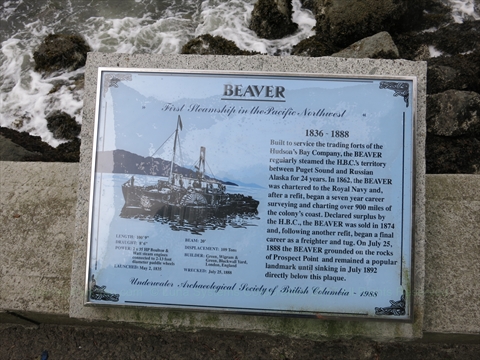
The SS Beaver Plaque commemorates the first steamship to operate in the waters of the Pacific Northwest, which tragically ran aground and wrecked directly off the coast of Stanley Park.
In addition to this waterfront installation, there is a dedicated historic cairn up at the elevated Prospect Point lookout area that features an abundance of extra historical data, blueprints, and archival stories about the vessel's decades of local marine service.
Plaque Inscription
Beaver
First Steamship in the Pacific Northwest
1836-1888Built to service the trading forts of the Hudson's Bay Company, the BEAVER regularly steamed the H.B.C.'s territory between Puget Sound and Russian Alaska for 24 years. In 1862, the BEAVER was chartered to the Royal Navy and, after a refit began a seven year career surveying and charting over 900 miles of the colony's coast. Declared surplus by the H.B.C., the BEAVER was sold in 1874 and, following another refit, began a final career as a freighter and tug. On July 25, 1888 the BEAVER grounded on the rocks of Prospect Point and remained a popular landmark until sinking in July 1892 directly below this plaque.
Specifications: Length: 100'9", Beam: 20'; Draught: 8'6"; Displacement: 109 Tons; Power: 2x35 HP Boulton & Watts steam engines connected to 2-13 foot diameter paddle wheels; Builder: Green, Wigram & Green, Blackwell Yard, London, England; Launched: May 2, 1835; Wrecked: July 25, 1888
Underwater Archaeological Society of British Columbia — 1988
SS Beaver Display at the Vancouver Maritime Museum
For a closer look at physical fragments recovered from the historic shipwreck, visitors can check out the permanent exhibits curated across town.
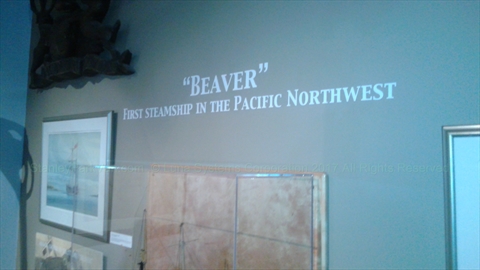
The Vancouver Maritime Museum hosts a large historical gallery overview dedicated entirely to the legacy of the SS Beaver. Artifacts inside the collection feature recovered machinery, blueprints, and shipwreck sketches.
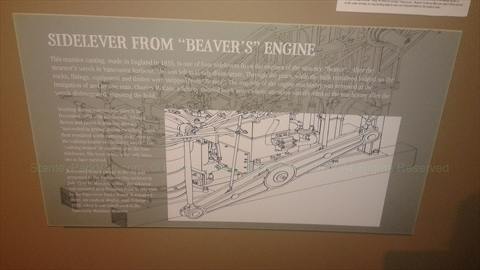
An indoor descriptive plaque profiles the diverse operational history of the steam paddlewheeler, contextualizing its service roles as a fur trade supply ship, naval survey craft, and harbor work tugboat.
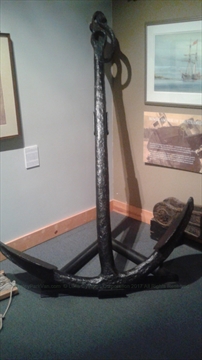
Among the most prominent salvaged machinery units on display is the ship's massive iron anchor array, safely preserved from underwater corrosion.
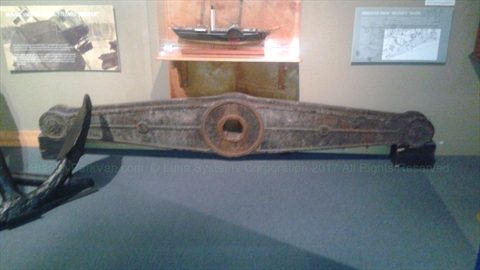
The exhibit also displays an original heavy iron engine sidelever mechanism, which transferred mechanical energy from the Boulton & Watts boilers to the 13-foot paddle wheels.
Where is the SS Beaver Plaque in Stanley Park?
The SS Beaver Plaque is located directly along the pathway alignment of the Stanley Park Seawall loop.
It is situated directly beneath the towering rock cliffs of Prospect Point, positioned just a short walking distance away from the shoreline perimeter path beneath the Prospect Point Lighthouse.